
New research has shed light on one of the earliest chapters in the Milky Way’s history, revealing evidence that our galaxy absorbed a smaller dwarf galaxy around 11.8 billion years ago. Scientists say the ancient collision helped shape the Milky Way during its infancy, adding stars, gas and dark matter as it developed into the vast spiral galaxy seen today.
Scientists Identify Milky Way’s Earliest Known Galactic Merger
The Milky Way, home to hundreds of billions of stars including the Sun, has undergone a long and complex evolution to reach its present size and structure.
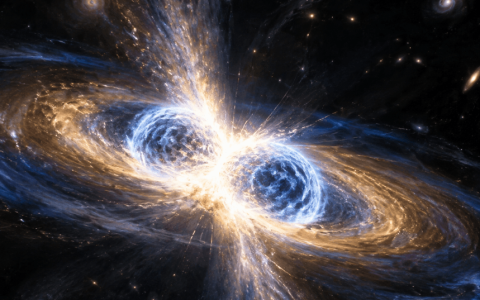
Researchers studying clusters of stars near the centre of the galaxy have found evidence that the Milky Way swallowed a smaller galaxy roughly 11.8 billion years ago, when the universe was less than 15 per cent of its current age.
The discovery represents the earliest known galactic merger involving the Milky Way and provides new insight into how the galaxy expanded through both its own star formation and the absorption of smaller galaxies caught by its gravitational pull.
The smaller system was a dwarf galaxy, a category of galaxies significantly less massive than large systems such as the Milky Way.
Scientists estimate that, at the time of the merger, the dwarf galaxy contained stars with a combined mass equivalent to about 500 million Suns. That made it approximately one-quarter the size of the Milky Way at the time.
Hubble and Gaia Reveal Evidence of Ancient Collision
Researchers used observations from the orbiting Hubble and Gaia space telescopes to examine stellar clusters in the Milky Way’s innermost 20,000 light-years.
Each cluster contains hundreds of thousands of stars. Scientists analysed their ages, chemical compositions and trajectories to reconstruct their origins and determine how they became part of the Milky Way.
A light-year, the distance travelled by light in one year, is approximately 9.5 trillion kilometres.
The analysis indicates that these stars joined the Milky Way following a galactic merger about two billion years after the Big Bang.
Ancient Galaxy Named Low-energy-Kraken-Heracles
Researchers have named the dwarf galaxy Low-energy-Kraken-Heracles, or LKH, acknowledging three earlier studies that explored evidence for such a primordial merger.
“The key finding of our research is the unambiguous discovery of the first merger event experienced by our galaxy in its infancy,” said astrophysicist Davide Massari of Italy’s National Institute for Astrophysics, or INAF, in Bologna.
Massari is the lead author of the study, which was published in the journal Nature Astronomy.
Scientists have long debated whether the Milky Way’s early expansion was driven mainly by stars forming within the galaxy or through mergers with other galaxies.
The latest research suggests the LKH merger provided the young Milky Way with a substantial influx of stars and interstellar gas, which fuels the formation of new stars. The merger also brought additional dark matter, the mysterious substance believed to account for much of the universe’s matter.
Merger May Have Triggered Major Star Formation
Massari said the collision was relatively calm from the perspective of individual stars but potentially much more dramatic for the gas within the two galaxies.
“I would say that from the point of view of stars, the merger was rather peaceful, with no star-to-star crashes. But from the point of view of the gas, the merger was more ‘explosive’ — likely, the collision between the gas from LKH and that from the Milky Way triggered the formation of many stars,” Massari said.
Many stars originally formed in LKH are likely to remain hidden within the Milky Way’s inner regions, including some inside stellar clusters.
Identifying individual stars in this part of the galaxy remains challenging because thick interstellar dust obscures observations.
Other Galactic Mergers Helped Shape the Milky Way
The Milky Way is already known to have experienced at least two other major mergers during its history.
It absorbed the Gaia-Sausage-Enceladus dwarf galaxy about 1.8 billion years after the LKH merger. During roughly the past six billion years, the Milky Way has also been gradually combining with the Sagittarius dwarf galaxy.
These events played an important role in determining the Milky Way’s structure, star populations and chemical evolution.
“Every single one of these mergers had an influence on the events that have led to the formation of our own solar system, and ultimately of Earth,” Massari said.
“This is why I think that reconstructing the pieces of the Milky Way’s past effectively contributes to answering the big question about, ‘Where do we come from?’”
The discovery of the ancient LKH merger provides scientists with another crucial piece of the Milky Way’s evolutionary history, showing how collisions and mergers billions of years ago helped build the galaxy that eventually became home to the Solar System and Earth.

Cory Weinberg is a contributor to Sproutwired.com, covering a wide range of topics including news, politics, business, technology, sport, entertainment and lifestyle. He focuses on delivering clear, balanced reporting that helps readers stay informed about current events and emerging developments. Cory’s work highlights relevant stories, practical insights and important issues affecting communities and industries, with an emphasis on accuracy, clarity and information that readers can trust.