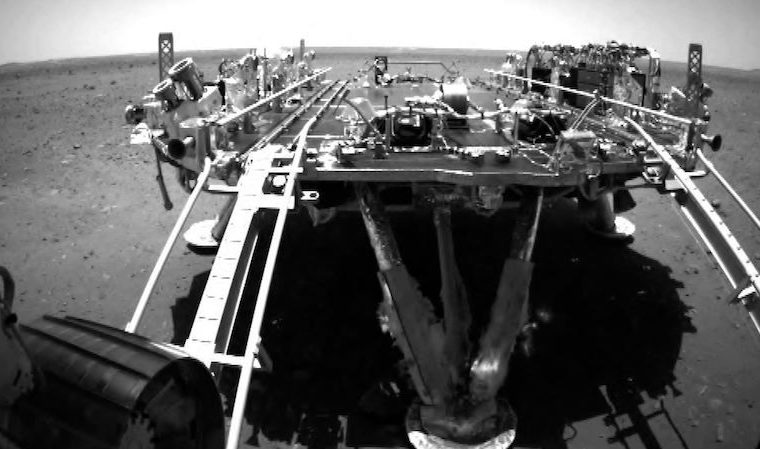
China became the second country after the United States to manage to transport an instrument to the surface of Mars that would then function properly. According to Reuters, this is also the first time that a country has been able to set up a satellite in its orbit during its first mission on Mars as well as successfully landed on the surface with a research vehicle.
China’s Tianmen Mars mission began last July with a launch from the Chinese Wenchang Space Center on Hainan Island. After a flight of less than seven months, the spacecraft – which includes a satellite, a landing module and a robotic vehicle – successfully reached a designated orbit around Mars in February.
Photograph of the Chinese module on Mars on 19 May.
Photo: Cnsa, Reuters
The satellite will remain in orbit and detect the planet from above using, among other things, high-resolution cameras, a spectrometer, a magnetometer, and a special radar designed to map the ice. It will also provide communications with the rover, whose equipment includes equipment for geological surveys and climate research, in addition to cameras, as well as a powerful radar that will look for potential pockets of water below the surface. Microbial life is found in such pockets on Earth.
The Chinese rover Utopia operates in the region of Planitia, i.e. on a plain in the Northern Hemisphere, which according to previous surveys is probably covered with lava and possibly permafrost. The American spacecraft Viking 2 landed in the region in 1976. There are now three US missions on Mars – the Insight Module and Curiosity Rovers and the latest Perseverance, which landed in February this year.

Sally Morgan is a contributor at Sproutwired.com, covering a broad range of topics including news, politics, business, technology, sport, entertainment, and lifestyle. She focuses on delivering clear, balanced reporting and practical information that helps readers stay informed about current events and emerging developments. Sally is committed to presenting stories in an accessible and engaging way, with an emphasis on accuracy, relevance, and issues that matter to everyday readers across Australia and beyond.