
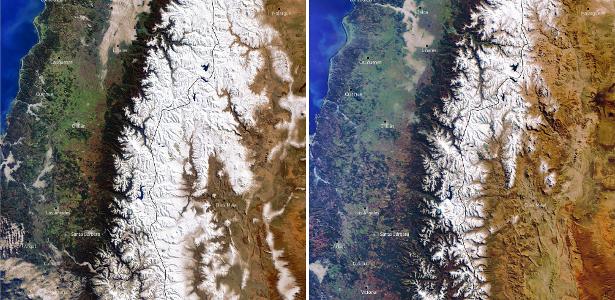
The Andes, which has always attracted skiers to the South American continent, is facing a historic decrease in snowfall this year during a decade-long drought that scientists say is the result of global warming.
Sparse rain and snow are leaving many of the majestic mountains, which stretch between Ecuador and Argentina, where there are irregular patches of snow, or no snow at all, leaving the gray earth of the peaks exposed.
Ricardo Villalba, lead researcher at the Argentine Institute of Snow, Glaciers and Environmental Science Studies, said that with rain falling and glaciers falling across the region, communities dependent on mountains for their water supply could face shortages.
“Here we are seeing a long-term process of falling precipitation, a mega-drought,” Villalba said.
“If we look at the rainfall levels now for the entire mountain range, they show that there was either no snow at all or very little snowfall,” the scientist said.
The Southern Hemisphere is currently going through winter, when it should be the height of snowfall.
Ski resorts have reopened after prolonged closures during the pandemic, and are attracting homesick skiers to the Argentina-Chile border. But the sparse snow is forcing many resorts to carry snow to cover the more popular slopes or to create artificial snow.

Muhammad Wayne is a contributor at Sproutwired.com, covering a broad range of topics including news, politics, business, technology, sport, entertainment, and lifestyle. He focuses on delivering clear, balanced reporting and useful information that helps readers stay informed about current affairs and emerging developments. His work aims to present relevant stories in an accessible and engaging way, with an emphasis on accuracy, context, and issues that matter to everyday readers.